Guest Lecture Shines Light on Overlooked History of Cinco de Mayo
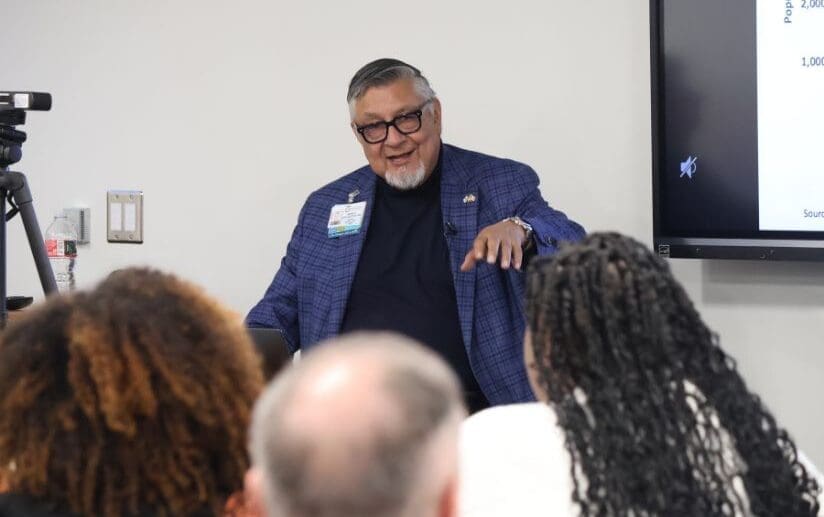
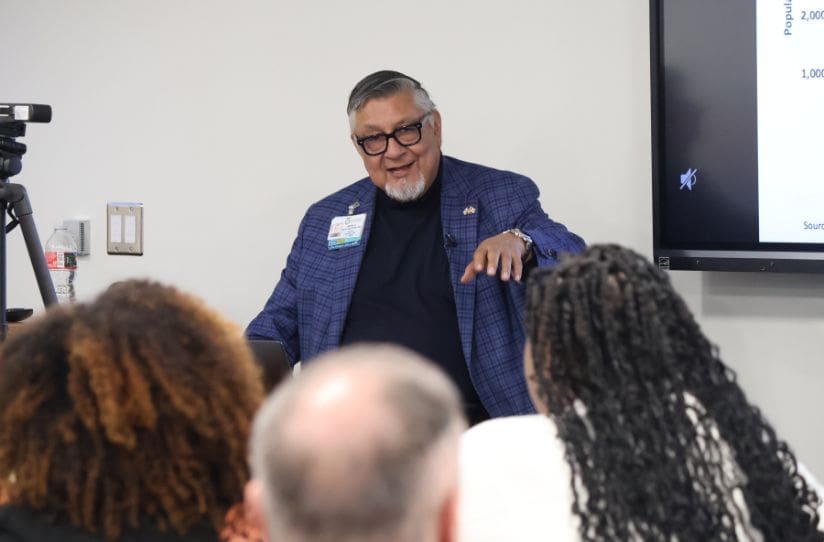
In recognition of Cinco De Mayo, Charles R. Drew University of Medicine and Science (CDU) hosted Dr. David E. Hayes-Bautista for a conversation on the holiday’s historical roots and its overlooked connections to broader struggles for freedom and justice.
An author and professor of medicine in the Division of General/Internal Medicine at David Geffen School of Medicine at UCLA, Dr. Hayes-Bautista has spent more than four decades advancing public understanding of Latino history, culture, and health.
During his visit, he challenged common misconceptions about Cinco de Mayo, highlighting the day as not simply a celebration of the Mexican army’s victory over French armed forces at the Battle of Puebla on May 5,1862, but as a moment deeply intertwined with the fight against slavery during the American Civil War.
“Every Cinco de Mayo during the Civil War, Latinos in California, Nevada, and Oregon would gather in great crowds to hear speeches, they would march in huge parades, and speakers would remind Latinos that they were struggling against both the slave states and their potential ally, the emperor of the French, Napoleon III,” said Dr. Hayes-Bautista.
His remarks also highlighted California’s rich history and the significant contributions of Latinos before and after the Mexican-American War. . He pointed out the Gold Rush beginning in 1848, the consequential Latino representation at the California Constitutional Convention of 1849, and the establishment of California as a bilingual state.
“Bilingualism is not a passing phenomenon,” he noted. “It’s a part of what California is.”
The conversation took on added depth as Dr. Hayes-Bautista drew a connection between Cinco de Mayo and Juneteenth. Following France’s defeat in Mexico, Emperor Maximilian was executed on Juneteenth in 1867, symbolically linking two histories shaped by resistance to systems of oppression.
Through hosting conversations that bridge cultures and challenge assumptions, CDU continues its commitment to cultivating leaders grounded in social justice and health equity, ensuring that moments of celebration are also opportunities for learning, reflection, and a deeper understanding of the shared pasts that shape communities today.