Student Innovation Shines at 2nd Annual BSEP Pitchfest Competition
The Biomedical Sciences Enrichment Program (BSEP) hosted its 2nd annual BSEP Pitch Fest Competition, where 15 program fellows showcased bold, research-driven proposals designed to tackle pressing health disparities in underserved communities.
Held in Keck Auditorium—transformed for the afternoon into a space evoking the ambiance of a TEDx talk and the high-stakes energy of a Shark Tank set—the event was a celebration of innovation and purpose.
Excitement and curiosity buzzed throughout the auditorium as attendees listened intently to five compelling pitches, each delivered to a panel of judges that included representatives from NASA and professionals in the biomedical field. Every proposal offered a creative and community-centered solution to real-world challenges affecting marginalized populations—from wound healing in unhoused individuals to carcinogen detection in everyday beauty products.
Arielle McGlone, Cristian Santos Santos, and Joshua Tate-Roberts opened the event with “Derma-LeapH,” a proposal to advance electroactive, hydrophobic PVDF-based bandages that could significantly improve wound healing outcomes among soldiers and unhoused communities. William Bradford, Alan Dominguez, and Saayli Khambekar followed with a pitch focused on the early detection of respiratory and cardiac diseases in vulnerable and overlooked populations.
Miracle Gosier, Derron J. Lopez, and Anyela Saa then introduced “RejuvaPulse,” a self-powered electroactive wound care system aimed at accelerating healing in chronic diabetic ulcers—offering hope for patients facing life-threatening complications from seemingly minor wounds. “I’m proud to bring an innovative solution to a crucial problem facing underserved communities,” said Saa. “It’s very important to bring a solution that is marketable, easy, and effective.”
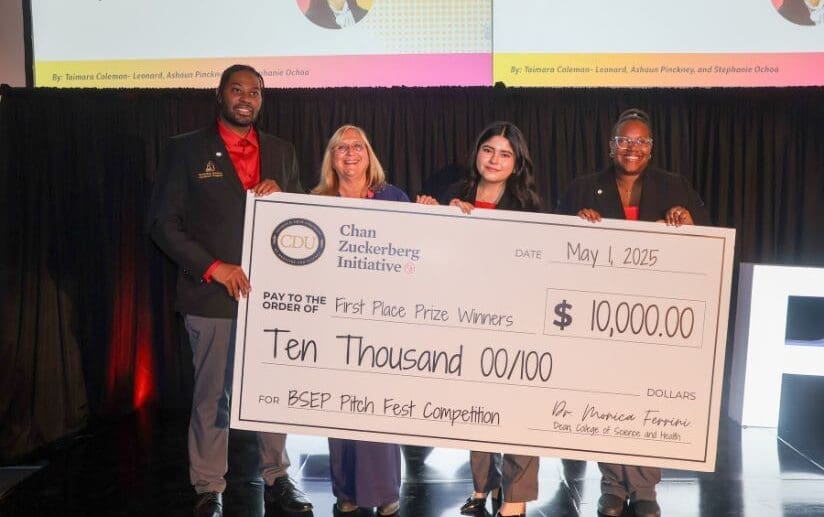
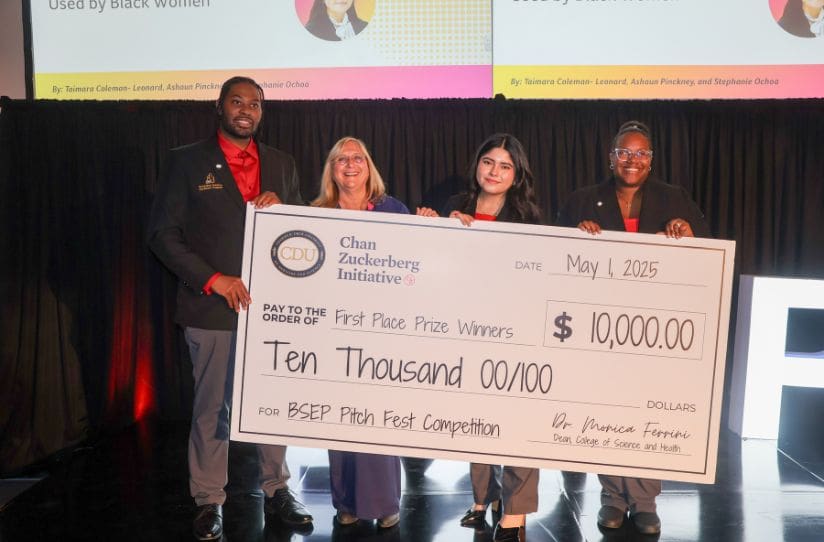
Taimara Coleman-Leonard, Ashaun Pickney, and Stephanie Ochoa unveiled “Strands of Safety,” a portable testing kit designed to detect carcinogenic exposure in hair products frequently used by Black women. “It means that we’re able to make better consumer product choices,” said Coleman-Leonard. “If I look at a brand and it comes up with high levels of carcinogens, maybe I can pick one that doesn’t have as much, or none… That’s why we created this product—so we could be able to see what’s in it.”
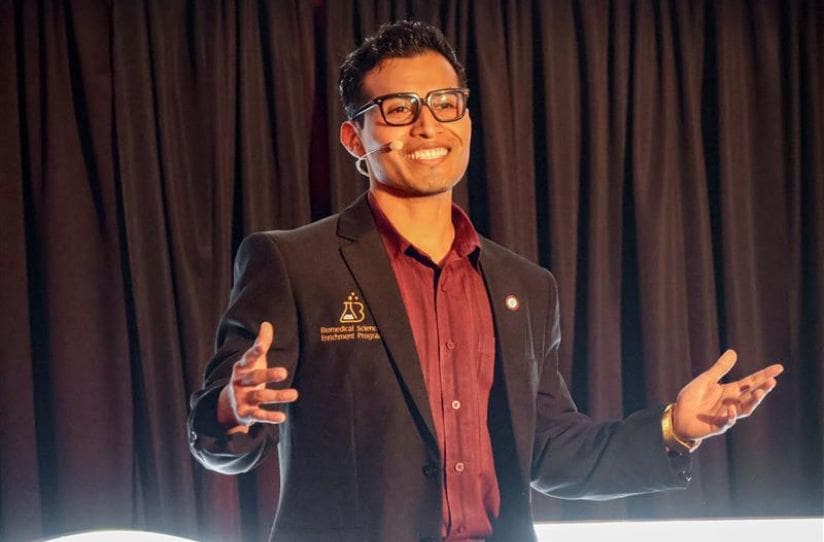
The final presentation of the afternoon came from Neda Kubiak, Kareena Prasad, and Tom Barber, who proposed a novel use of electroactive wound-healing bandages to support emergency personnel and reduce the burden on healthcare systems during mass casualty events.
While every pitch displayed remarkable creativity and promise, only two teams could claim top honors. “Strands of Safety” earned the first-place prize—a $10,000 grant, while “RejuvaPulse” took second place and received a $3,000 grant. The grants will help the students move their proposals closer to reality, furthering their missions to serve communities too often left behind in health innovation. The event’s sponsors and partners included the Chan Zuckerberg Initiative, Figs, Technology Transfer University, and Kaiser Permanente.