Students Tackle Health Disparities at Inaugural BSEP Pitchfest
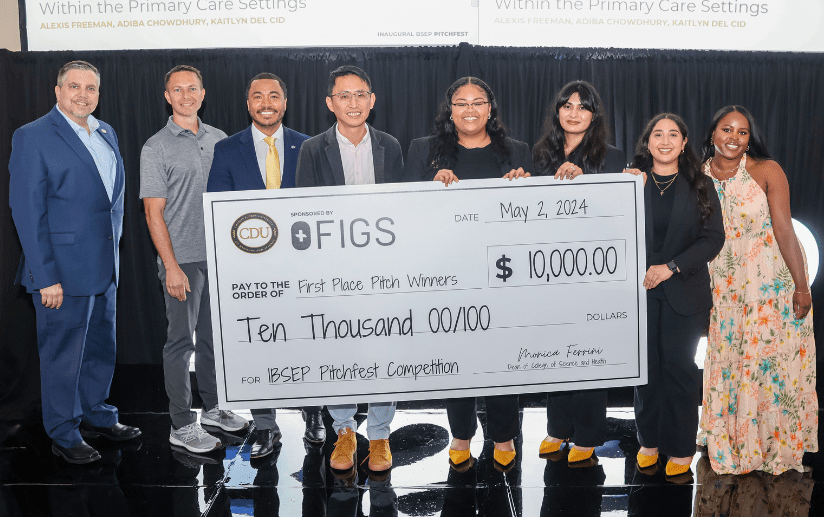
The Biomedical Sciences Enrichment Program (BSEP) hosted the inaugural BSEP Pitchfest Competition where the fellowship cohort of 18 students unveiled their groundbreaking ideas to combat health disparities that are prevalent in underserved communities.
The event was held in Keck Auditorium which was transformed to set the stage for the event, taking on the ambiance of a TEDx talk and the intense energy of a Shark Tank pitch. With a stage installed and vibrant lighting illuminating the space, attendees were immersed in an extraordinary experience.
There were a total of five innovative solutions presented directly to a panel that included representatives from NASA alongside biomedical professionals.
Students Bria Myles, Jessica McCarns, and Anna Monterastello kicked off the presentations with their pitch titled, “Utilizing QuickSee Autorefractor to Predict Visual Acuity in School-Age Children,” which aims to assess and address the visual needs of our youngest learners.
Following suit, Keerthana Muthukrishnan, Nandi Favors, Mercedes Humski, Sandrine Lynda Djousta, Shannon Changizi, showcased their proposal, “Application of a Thermoplastic Fluoropolymer (PVDF) to Stimulate Electro-Activated Healing of Sores,” promising to revolutionize wound care for those negatively affected by traditional treatments.
Then, students Daniel Hernandez, Karina Manuel-Jiminez, Jesus Terrazas, JR, and Margo Contreras, stepped up to share their vision in “3D Model Penetration: Using Microorgan Device as an Alternative to Animal Testing,” offering a glimpse into a future of biomedical research that includes a substantial decrease in reliance on animal testing and a profound ethical shift in the way researchers approach scientific inquiry.
The momentum continued as Lillian Cohen, Shahara Thompson, and Sawyer Torres unveiled their inspiring proposal “Novel MCT-4 Inhibitor: Potential for Combination Therapy to Reduce Multi-Drug Resistance in Acute Myeloid Leukemia.” Their research offers hope for more effective treatment strategies and represents a significant stride forward in combating the devastating disease.
Rounding out the presentations were Alexis Freeman, Adiba Chowdhury, and Kaitlyn Del Cid, who took the stage with their pitch titled, “Nanosensor Array and Efficient Diagnoses of Type II Diabetes in Low-Income Communities Within the Primary Care Settings.” Their innovative approach, which promises improved diagnostic accuracy and caters to individuals that may be averse to traditional needle-based testing methods, stands as a beacon of hope in the fight against one of the leading causes of death in low-income communities.
While every presentation demonstrated remarkable promise and innovation, only two could emerge victorious. The “Nanosensor Array and Efficient Diagnoses of Type II Diabetes in Low-Income Communities Within the Primary Care Settings” team took the first-place position and a grand prize of $10,000 courtesy of FIGS. The second-place winners were the presenters of “Utilizing QuickSee Autorefractor to Predict Visual Acuity in School-Age Children,” and they were awarded a $3,000 grant courtesy of Chan Zuckerberg Initiative and Kaiser Permanente.
“I think it’s such a big thing that we are three women in STEM who just won this award,” said Kaitlyn Del Cid. “I hope that we can also be women that other women and little girls interested in STEM can look up to and see that hard work and dedication pays off.”