The Doctor of Medicine curriculum prepares students to become skilled, compassionate physician-leaders equipped to improve health outcomes in under-resourced communities.
Inspired by Dr. Glenda Lindsey, a pediatrician and CDU faculty member who helped shape the program, the DREAM Curriculum is organized into three phases.
Across four years, students move from foundational sciences and organ-system instruction to clinical clerkships, advanced electives, scholarly work, and residency preparation. Drew’s Research, Engagement, Advocacy, and Medical Leadership are integrated throughout the curriculum.
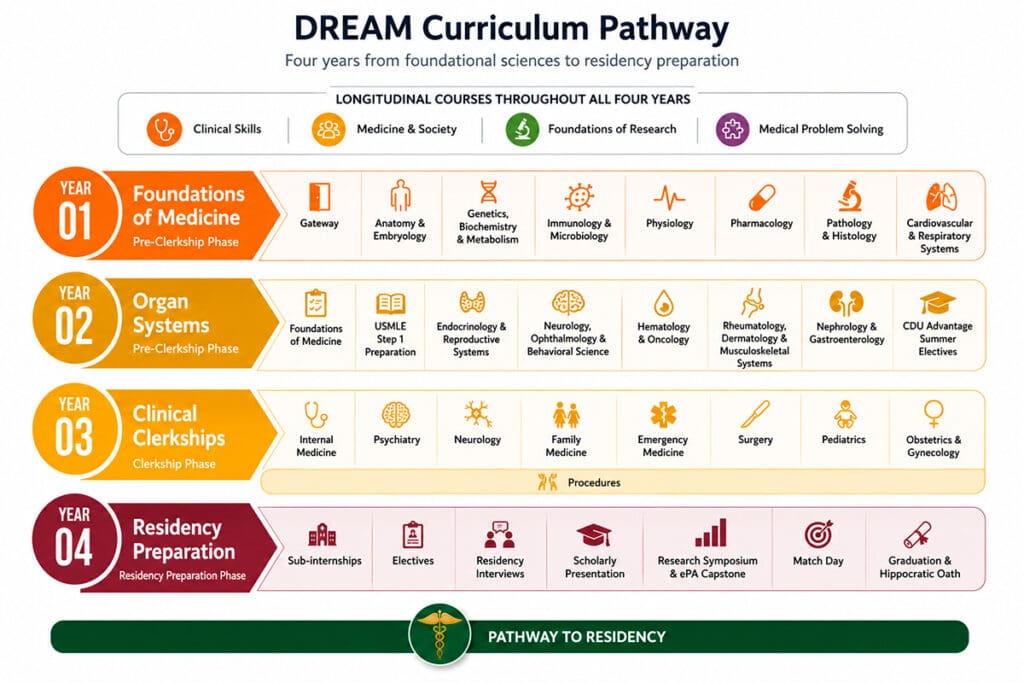
Four longitudinal courses extend across the curriculum:
- Clinical Skills
- Medicine and Society
- Foundations of Research
- Medical Problem Solving
Together, these courses connect scientific knowledge, clinical practice, research, community engagement, advocacy, and professional leadership.
Year One: Foundations of Medicine
The first year establishes the scientific and clinical foundation students need to understand human health, disease, and patient care.
Students begin with Gateway and foundational coursework in:
- Anatomy and Embryology
- Genetics, Biochemistry, and Metabolism
- Immunology and Microbiology
- Physiology
- Pharmacology
- Host Defense and Pathology
- Cardiovascular and Respiratory Systems
Throughout the year, students also begin developing clinical reasoning, communication skills, research experience, and an understanding of the physician’s role in society.
Year Two: Organ Systems
During the second year, students build on the foundational sciences through integrated organ-system instruction and continued clinical preparation.
Coursework includes:
- Foundations of Medicine
- USMLE Step 1 Preparation
- Endocrinology and Reproductive Systems
- Neurology, Ophthalmology, and Behavioral Science
- Hematology and Oncology
- Rheumatology, Dermatology, and the Musculoskeletal System
- Nephrology and Gastroenterology
- CDU Advantage Summer Electives
Students continue participating in Clinical Skills, Medicine and Society, Foundations of Research, and Medical Problem Solving as they prepare to enter clinical clerkships.
Year Three: Core Clinical Clerkships
The third year places students in clinical settings where they apply classroom knowledge to direct patient care under the supervision of faculty and clinical preceptors.
Core clerkships include:
- Internal Medicine
- Psychiatry
- Neurology
- Family Medicine
- Emergency Medicine
- Surgery
- Pediatrics
- Obstetrics and Gynecology
- Clinical Procedures
Students also continue their longitudinal coursework and complete required clinical assessments as they strengthen their diagnostic, communication, teamwork, and patient-care skills.
Year Four: Residency Preparation
The fourth year focuses on advanced clinical training, career development, scholarly completion, and preparation for residency.
Students complete:
- Sub-internships
- Electives
- Residency interviews
- Scholarly presentations
- Research symposium and electronic portfolio capstone
- Match Day activities
- Graduation and the Hippocratic Oath
This final phase allows students to deepen their experience in selected specialties, demonstrate increasing clinical responsibility, and prepare for the transition from medical student to resident physician.