Mass Casualty Simulation Prepares Students
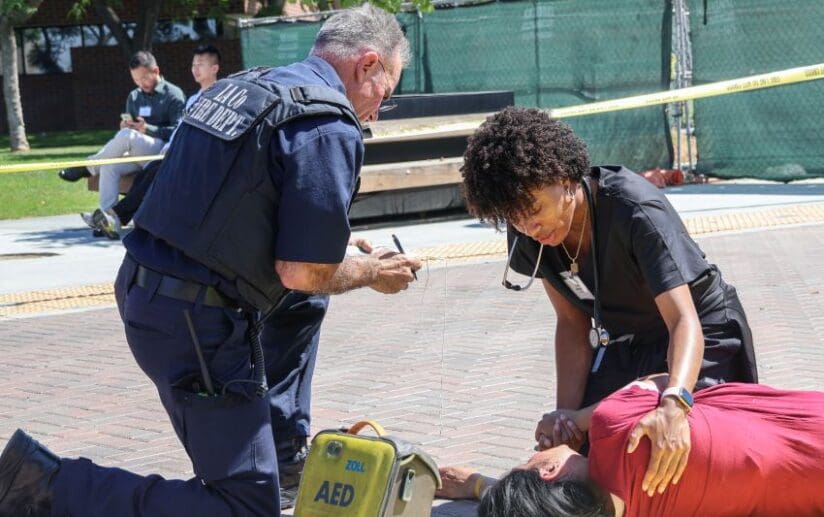
IMPORTANT DISCLAIMER: CDU held a simulated mass casualty event on campus, including crisis actors, to create a learning opportunity for students. In the spirit of the role-playing event, the following fictional story was written by a CDU staff member posing as a member of the media on the scene!
The students of Charles R. Drew University of Medicine and Science in South Los Angeles demonstrated amazing skills, care, and compassion under extreme pressure following a shocking mass casualty event that unfolded adjacent to the campus on the morning of August 8.
At least 15 individuals were found injured when the CDU students, the only people with any medical training in the area at the time, responded to the crisis.
The reported casualties included light injuries along with critical life-threatening wounds, some of which were sustained during the chaos that unfolded trying to escape the incident.
The injured, guided by the CDU first responders, found themselves receiving evaluations and treatment on the lawn while awaiting the arrival of medical emergency personnel. The wounded included a 26-year-old pregnant woman.
“When we got to her, she had two open wounds in her right leg; so first, we did a tourniquet to stop the bleeding and then we placed the stint, wrapped it around, and stabilized the leg,” said Sabrina Montgomery, a first-year medical student in the CDU 4-Year Medical Degree program. “We also checked her vitals and the baby’s vitals.”
Montgomery, a first year MD program student, was among 8 interprofessional teams of CDU students that mobilized along with emergency service professionals to provide medical aid to the wounded persons laid out on the University’s lawn.
“I think at first, I was like ‘woah, what do we do?’ because we didn’t have supplies,” said Montgomery. “Once we got the supplies, I started to feel a little bit better because there was something that we could do and then from there, I feel like the anxiety went down as we were getting her more stabilized.”
At the time of the incident, 60 CDU Medical Degree students and 26 CDU Physician Assistant students were participating in procedural skills simulation stations. The stations which consisted of triage station, airway management station, cricothyrotomy station, chest tube/needling station, stop the bleed station, fracture stabilization and splinting station, intraosseous/IV placement station, and BLS/ First Aid station proved to be beneficial to students as they were presented with a real-life tragedy.
According to Dr. Shanika Boyce, Assistant Professor and Director Service Learning and Pre-Clerkship Clinical Education for the CDU 4-Year Medical Program, the medical degree students that quickly sprang into action are in their orientation of medical school and have not yet started their first medical school classes.
“I was able to go to each of the different groups and they definitely were engaged with their patient, and they understood what was happening,” shared Dr. Boyce. “We kind of went over things like how they would triage their patient and they were able to do so appropriately and definitely for their level right now.”
Dr. Boyce’s observations of the students’ engagement and appropriate response underscored CDU’s commitment to preparing healthcare professionals who understand the unique needs of underserved communities and can provide competent care even in high-stress situations.
“It was excellent how they handled the situation,” said Dr. Boyce. “Initially you could tell that they were anxious about it, but then as they kind of understood what was happening you could see that their levels of anxiety decreased.”
The response time of the official emergency medical services, including EMTs and firefighters, was approximately 15 minutes. Their arrival marked a turning point in the incident, as they were able to immediately transport the victims to nearby hospitals for further treatment, with the severity of injuries varying from minor to critical.
In the face of tragedy, CDU’s value of “community” as one of the driving forces behind their educational approach shone through as these future health professionals demonstrated their ability to handle real-life disaster situations with compassion and excellence.
The university’s commitment to producing healthcare leaders who prioritize social justice, health equity, and community engagement was exemplified by the actions of its students during this challenging time.